Corporate innovation requires both doing different things and doing things differently.
Photo by Austin Distel on UnsplashIn today’s relentlessly evolving business landscape, the term ‘innovation’ echoes through boardrooms and strategy m...

In today’s relentlessly evolving business landscape, the term ‘innovation’ echoes through boardrooms and strategy meetings as a critical imperative. Yet, what does corporate innovation truly entail? It’s often perceived as the pursuit of the radically new, the disruptive breakthrough that reshapes markets.
While that’s part of the picture, a more holistic understanding reveals a crucial duality. True, sustainable corporate innovation isn’t just about venturing into uncharted territories (Doing different things), but also about doing same things around core business differently i,e. reimagining and refining the existing operational core. Furthermore, the engine driving both these vital streams of innovation often lies dormant within the organization itself its existing assets.
This piece expands into these two fundamental pathways of corporate innovation, exploration and optimization, and underscores how companies can unlock significant potential by strategically leveraging the resources, capabilities, and infrastructure they already possess and finding the balance between the two.
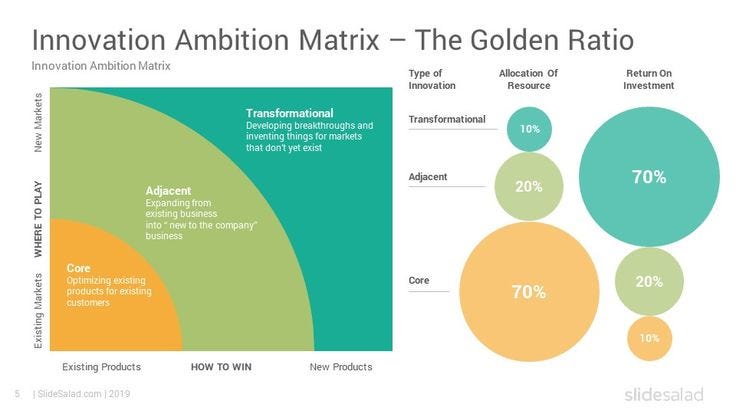
The decision on whether to focus on venturing into uncharted territories or focus on optimizing the core depends on the each corporate’s ambition, risk appetite and availability of resources and business strategy. And there is also a room to balance the two approaches thus benefit from the rewards of explorative innovation and optimizing the core.
Doing Different Things: The Exploration Imperative
The first pillar of comprehensive corporate innovation is the bold act of doing different things. This is the realm of exploration, where companies courageously step beyond their established boundaries to discover and cultivate entirely new avenues for growth.
As the framework highlights, exploration involves identifying and pursuing fresh business opportunities, developing novel products, or introducing services that significantly differ from the company’s current portfolio. It’s about asking “What else could we do?” rather than just “How can we do our current activities better?” This path is characterized by its inherent novelty and its potential to redefine markets or create entirely new ones.
Think of a traditional manufacturing company venturing into software-as-a-service, or a retail giant launching an innovative logistics arm that serves external clients. These exploratory moves often require significant investment and carry a higher degree of uncertainty, as the company navigates unfamiliar customer needs, competitive landscapes, and operational challenges.
However, the potential rewards are equally substantial, offering pathways to exponential growth, diversification, and the establishment of new competitive advantages that can secure the company’s future relevance beyond existing core business.
Doing Things Differently: The Optimization Advantage
Complementing exploration is the equally vital practice of doing things differently. This represents the optimization pathway of innovation, focusing inward to enhance and reimagine how the company currently operates and delivers value.
As defined in the framework, optimization involves scrutinizing existing processes, products, or business models and finding ingenious ways to improve them. This isn’t about maintaining the status quo; it’s about continuous refinement and intelligent adaptation.
Examples abound, from implementing automation and AI to streamline manufacturing or customer service processes, adopting agile methodologies to accelerate product development cycles, redesigning a user interface for a software product based on user feedback, or shifting a traditional sales model towards a subscription-based approach for recurring revenue.
Optimization often yields more immediate and predictable returns compared to exploration, such as increased efficiency, reduced operational costs, improved product quality, enhanced customer satisfaction, and a stronger competitive footing within established markets. While perhaps less glamorous than radical exploration, consistent optimization is crucial for maintaining operational excellence, freeing up resources, and building a resilient foundation upon which future exploratory ventures can be launched.
The Power Within: Leveraging Existing Assets
A critical insight from the framework is that neither exploration nor optimization happens in a vacuum. Both pathways are fundamentally fueled by leveraging existing assets.
This concept shifts the focus from solely seeking external resources or building everything from scratch to strategically utilizing the wealth of resources, capabilities, and infrastructure that a company already possesses.
These assets are diverse and potent, encompassing tangible elements like funding, infrastructure, and technology, as well as intangible strengths such as established customer access, brand reputation, accumulated data, valuable patents, and, crucially, the skills and knowledge of its talent pool.
The true art of corporate innovation lies in recognizing the latent potential within these existing assets and creatively deploying them. For instance, a company’s strong brand recognition and loyal customer base can significantly de-risk the launch of a new product line (exploration).
Similarly, existing data on customer behavior can be analyzed to identify bottlenecks in the customer journey, leading to process improvements (optimization). Access to internal funding can enable pilot projects for both new ventures and efficiency drives. By viewing existing assets not just as operational necessities but as strategic springboards for innovation, companies can unlock powerful synergies, accelerating both their ability to do different things and to do existing things differently, ultimately creating a more robust and sustainable innovation engine.
Conclusion: Embracing the Full Spectrum of Innovation
In conclusion, navigating the complexities of the modern business world demands a sophisticated approach to corporate innovation. It requires moving beyond simplistic definitions and embracing the essential duality presented in the framework: the outward-looking drive of exploration (doing different things) balanced with the inward-focused refinement of optimization (doing things differently). Pursuing only one path leads to an incomplete strategy. Exploration without optimization can lead to unsustainable ventures, while optimization without exploration risks stagnation and eventual irrelevance.
The true power, however, lies in recognizing that the fuel for both these engines resides within the organization itself. By strategically identifying, valuing, and leveraging existing assets from financial resources and brand equity to talent and technological infrastructure, companies can effectively power both groundbreaking ventures and continuous improvements.
Cultivating a corporate culture that understands and actively supports this balanced approach, underpinned by the intelligent use of internal strengths, is paramount for achieving resilient growth and enduring success in an ever-changing landscape.